
author: Mara Krause, 21.01.2026
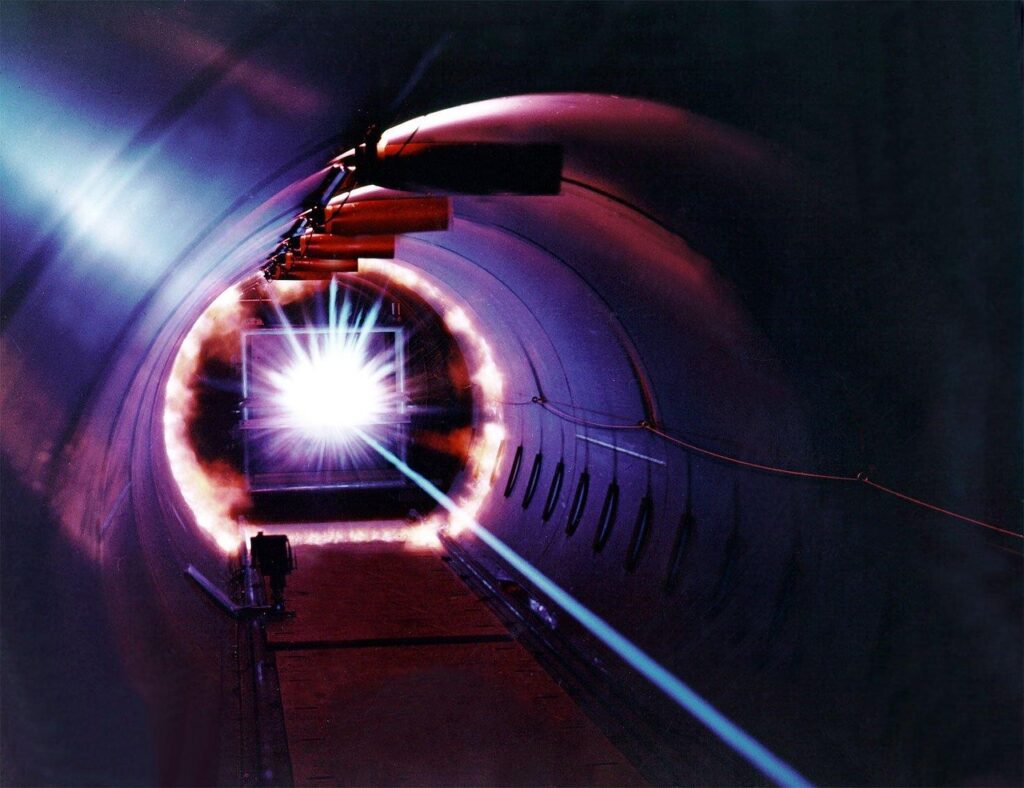
What is a petawatt laser?
A petawatt laser is a high-intensity laser which generates peak powers of quadrillion (10^15) watts (petawatts). They typically produce laser pulses that are extremely short, lasting only a few femtoseconds.
Petawatt laser use the CPA technique to perform at these high energies. They proofed to be extremely useful in lots of scientific research and enabled one of the biggest scientific breakthroughs in recent years: Inertial Confinement Fusion (ICF). (click here to read my article about ICF) By concentrating energy in a small volume, these laser create extreme conditions previously accessible only in astrophysical environment. Scientists hope this field of research could contribute enormously to future clean energy.
Which technological advancements led to the creation of petawatt laser?
In 1960 Theodor H. Maiman invented the first laser with a peak power (highest power a laser produces) of kilowatts. It was the first time that a source emitted coherent light, meaning the light is synchronised in phase, which is necessary for lasers.
After a decade, the peak power increased from kilowatts to gigawatts and even more. Science faced a whole new opportunity for research and exploring deeper structures of nature. However, the improvement of laser power slowed down and not much happened from the 1970s to mid-1980s.
Then, CPA was invented and changed laser physics. In 1985, Donna Strickland with Gerard Mourou invented the Chirped Pulse Amplification (CPA). (6)
Nowadays, nearly all high-intensity lasers operate under the CPA-system. For instance, the ZEUS laser (Zettawatt-Equivalent Ultrashort pulse laser System), a newly constructed multi-petawatt dual-beam facility at the University of Michigan.
How exactly do CPA laser work?
Chirped Pulse Amplification (CPA) is a concept to overcome fundamental limitations that conventional lasers face when increasing peak power. While conventional continuous-wave laser establish high average power, attempts to increase peak power fail mainly because they would damage the laser material.
Laser systems can be divided into continuous-wave and pulsed lasers. Continuous-wave (CW) laser distribute power uniformly in time. Pulsed laser systems, however, concentrate their energy in ultrashort intervals. These pulses are usually only femtoseconds long (10^-15s). Since power is energy per time, compressing the average power of CW lasers into an ultrashort pulse, drastically increases the peak power, even reaching petawatts. However, these powers are too high for a conventional laser because while reflecting, the material would be damaged.
To understand where the limitations arise, I will shortly explain the operation of a conventional laser.
LASER stands for Light Amplification Stimulated Emission (of) Radiation. It typically consists of a pump source, a gain medium and an optical resonator formed by two mirrors.
The pump source pumps energy into the gain medium, exciting atoms into higher energy states. Under thermal equilibrium, the gain medium has more particles in a lower energy state due to Boltzmann distribution. Laser need to establish a population inversion, meaning the number of particles in an excited state is higher than the number in an unexcited state.
When a photon passes through a medium, it can trigger stimulated emission. The photon stimulates an excited atom to emit a coherent (identical frequency, direction…) photon. This is called stimulated emission (SE in LASER) and was first described by Albert Einstein in 1917.
The resonator then reflects the beam of photons several times through the gain medium via mirrors, creating more coherent photons and interfering waves. One mirror is partially transparent, allowing a fraction of the amplified light to exit as the laser beam.
This is the oscillator-based concept for conventional lasers.
But in pulsed laser, energy is concentrated into extremely short pulses which increases the peak power as power is energy per time. This leads to the problem that optical components like mirrors can be damaged.
To solve the problem, CPA lasers were developed in 1985, working like a conventional laser with a few changes. The key insight was that optical damage depends on intensity (power / area), not total energy:
- A short pulse of low intensity is stretched in time in a grating pair before amplification to prevent damage to the optical components. This is the key difference to conventional ones and enables to work with higher energies. By stretching the pulse, the peak intensity decreases. The granting pair diffracts the pulse, meaning they typically delay shorter wavelengths more than longer ones to create the chirped pulse and prevent peak powers in the optical components.
- The long pulse of low intensity is passed through a series of amplifiers (with population inversion) which amplify the stretched pulse and increase its intensity. The pulse stimulates the excited particles of the amplifier and identical photons are emitted. This „cloning “of the pulse is what increases its energy. Unlike in a conventional laser where the amplified pulse is reflected in the resonator, the amplifier of the CPA is designed for energy extraction.
- In the end, the long pulse of high intensity is compressed back to its original duration in a grating pair by routing longer wavelengths on a longer path. A short pulse of high intensity is released, a high-peak-power-flash.
Scientists at the University of Michigan have constructed a high-power laser facility called ZEUS. In a paper („The Zeus multi-petawatt laser system “) published in October 2025, they state that the ZEUS laser uses Ti: Sapphire (Ti: Sa) as a gain medium, a solid sapphire crystal doped with titanium. This titanium doped crystal has a wider luminescent spectral bandwidth which is essential for supporting the ultra-short pulses (femtoseconds). The Titanium ions in the sapphire crystal have broad vibrionic energy levels, resulting in a big emission bandwidth. (3)
What has been achieved?
The ZEUS laser has achieved a power of 2 petawatts with a pulse duration of 15 femtoseconds. However, its unique geometry allows the petawatt laser pulse to collide with a GeV-energy electron beam which creates an interaction equivalent to a Zetawatt power laser. (3)
But the ZEUS laser doesn’t hold the current record which is a laser output of above 10 petawatts as of 2024-2025 from the Extreme Light Infrastructure for Nuclear Physics (ELI-NP) in Romania and development is ongoing at facilities such as the Shanghai Superintense Ultrafast Laser Facility (SULF) in China.
What are prospects for the future?
A 2024 review from the Colorado State University states: „The next milestone for high-power lasers is reaching 100 PW, with several systems currently under design and development. “(1) 100PW is the goal for 2030 for a Chinese team and 50PW for the University of Rochester in the USA.
Additionally, a post-compression technique with incorporated CPA promises further increase laser power to Exawatt (10^18) and even Zetawatt (10^21). (1)
Another prospect for the future is the application of petawatt lasers in LPA (Laser-plasma acceleration). LPA generates compact, high-energy beams of electrons, protons and ions. The laser produces strong electric fields within the plasma, stronger than the ones in particle accelerators, to accelerate over shorter distance and with more energy.
Among the most compelling applications of petawatt lasers is Inertial Confinement Fusion (ICF). The availability of ultralight-peak-power lasers has revolutionized this field, giving hope for new and clean energy sources, different form what was possible before.
References
1) V. Chvykov, „High-power lasers,“ Encyclopedia, 4, 1236–1249. (2024) https://doi.org/10.3390/encyclopedia4030080
2) M. Roth et al., „Laser accelerated ions in inertial confinement fusion research: Prospects and experiments,“ Plasma Physics and Controlled Fusion, 47, B841–B850. (2005). https://doi.org/10.1088/0741-3335/47/12B/S66
3) A. Maksimchuk, J. Nees, B. Hou, R. Anthony, J. Bae, F. Bayer, M. Burger, P. T. Campbell, J. Cardarelli, V. Contreras, N. Ernst, F. Falcoz, R. Fitzgarrald, I. Jovanovic, G. Kalinchenko, C. Kuranz, J. Latham, Y. Ma, A. McKelvey, T. Nutting, Q. Qian, B. K. Russell, G. Sucha, A. G. R. Thomas, R. Van Camp, E. Viges, L. Willingale, G. Young, Q. Zhang, K. Krushelnick; „The ZEUS multi-petawatt laser system“. Phys. Plasmas.; 32, 103107. (2025). https://doi.org/10.1063/5.0283440
4) M. Ghoranneviss, A. Salar Elahi, „Review on Recent Developments in Laser Driven Inertial Fusion,“ Advances in High Energy physics 2014, 802054. (2014) https://onlinelibrary.wiley.com/doi/10.1155/2014/802054
5) Cambridge University press, „Future for intertial-fusion energy in Europe: a roadmap“ (2023). https://repository.gsi.de/record/347787/files/future-for-inertial-fusion-energy-in-europe-a-roadmap.pdf#:~:text=The%20recent%20achievement%20of%20ignition%20at%20the,energy%20production%20and%20developing%20high%2Dlevel%20spin%2Doff%20technologies.
6) The Nobel Committee for Physics, „Groundbreaking Inventions in Laser Physics,“ (2018) https://www.nobelprize.org/uploads/2018/10/advanced-physicsprize2018.pdf
7) Ludwig-Maximilians-Universität München, „What is petawatt physics?“ https://www.pulse.physik.uni-muenchen.de/education/basics/index.html